User research is the methodological heart of the UX Designer's craft. It's the phase where you stop imagining what users want and start asking them — observing them, interviewing them, analyzing their real behavioral data. Without user research, a designer designs based on intuition; with user research, they design based on evidence.
This complete guide covers what user research really is, the main methods a designer uses every week, how to run effective research, the professional landscape for User Researchers in the US and UK in 2026, and how to break into the role.
What you'll learn:
- What user research is and why it's different from intuition
- The 7 main methods (competitor analysis, interviews, surveys, empathy maps, personas, customer journey, usability testing)
- How to choose the right method based on the research question
- The user research job market in the US and UK in 2026
- How to become a User Researcher
What user research is
User research is the set of methods a product team uses to collect information about real users — who they are, what they do, how they think, what they feel — to make design decisions grounded in evidence. The output isn't a 100-page document: it's actionable insights that change the decisions the team makes today and tomorrow.
It's a hybrid discipline: it combines qualitative methods (interviews, observation, diaries) and quantitative ones (surveys, A/B tests, analytics), statistical logic and anthropological sensitivity. Good researchers know when to use which method based on the question they're trying to answer.
Three core principles that separate serious research from "we asked someone":
- Start from the question, not the method. Decide what you want to understand, then choose the tool. Beginners do the opposite: they learn interviewing and apply it to every problem.
- Bias is invisible to the person introducing it. People don't lie when they answer leading questions: they actually believe what they say because you suggested it. The first researcher skill is recognizing your own bias.
- Behaviors say more than opinions. When users say "I'd use this feature every day" and then never use it, they're telling the truth about who they want to be, not about what they do.
Competitor analysis
The cheapest and most underrated starting point. Before asking users what they want, look at what the competition is already doing — and where they're failing.
What to analyze:
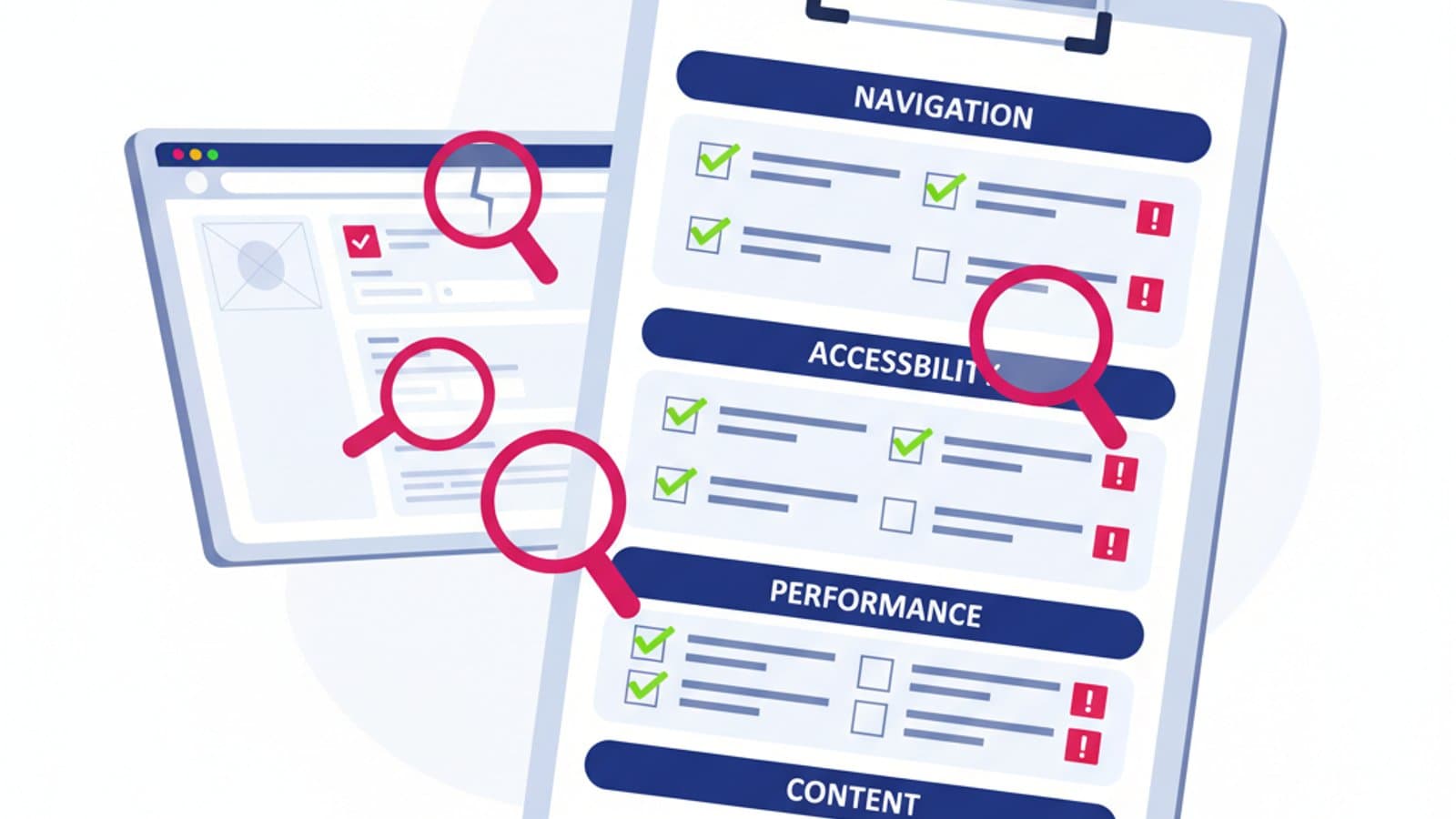
- Key flows (sign-up, onboarding, core tasks, checkout)
- Information architecture and navigation
- Tone of voice and microcopy
- Public competitor reviews (Trustpilot, App Store, G2, Reddit) to identify real user pain points
How to organize the data: a table with one row per competitor and one column per dimension you're evaluating, plus annotated screenshots in the notes. Store it in Notion or Figma.
When competitor analysis alone is NOT enough: when you're building something genuinely new without direct competitors, or when the question is about cognitive behaviors that transcend the specific product.
In-depth interviews
The most powerful method and the hardest to do well. A UX interview is a semi-structured 45-60 minute conversation with a target user to understand how they experience a situation, what problems they encounter, and how they solve them today.
The principles that separate a good interview from a bad one:
- Ask about the past, not the future. "Tell me about the last time you booked a trip online" produces reliable data. "Would you use this feature in the future?" produces speculative opinions.
- Resist silence. After an answer, wait 5-10 seconds before moving to the next question. The most valuable information often surfaces in that silence.
- Zero leading questions. "You liked it, right?" is leading. "What do you think?" is neutral.
- Five whys. When the user says something interesting, ask "why?" until you reach the real root — inspired by Toyota's "5 Whys" technique.
How many interviews do you need? 5-8 for a first exploratory round on a new problem. After 5-8 interviews with users in the same segment, new information starts to repeat (saturation). If the segments are different (e.g., novices + experts), you need 5-8 per segment.
To dig deeper into the method, read the guide to UX analysis.
Surveys and questionnaires
Useful when you need to validate at scale something you've already understood in small. A survey of 500 people is the right way to find out how widespread a problem is, not to discover what the problem is.
When to use surveys
- After a qualitative phase (interviews), to validate how widespread the emerging insights are in the larger target population.
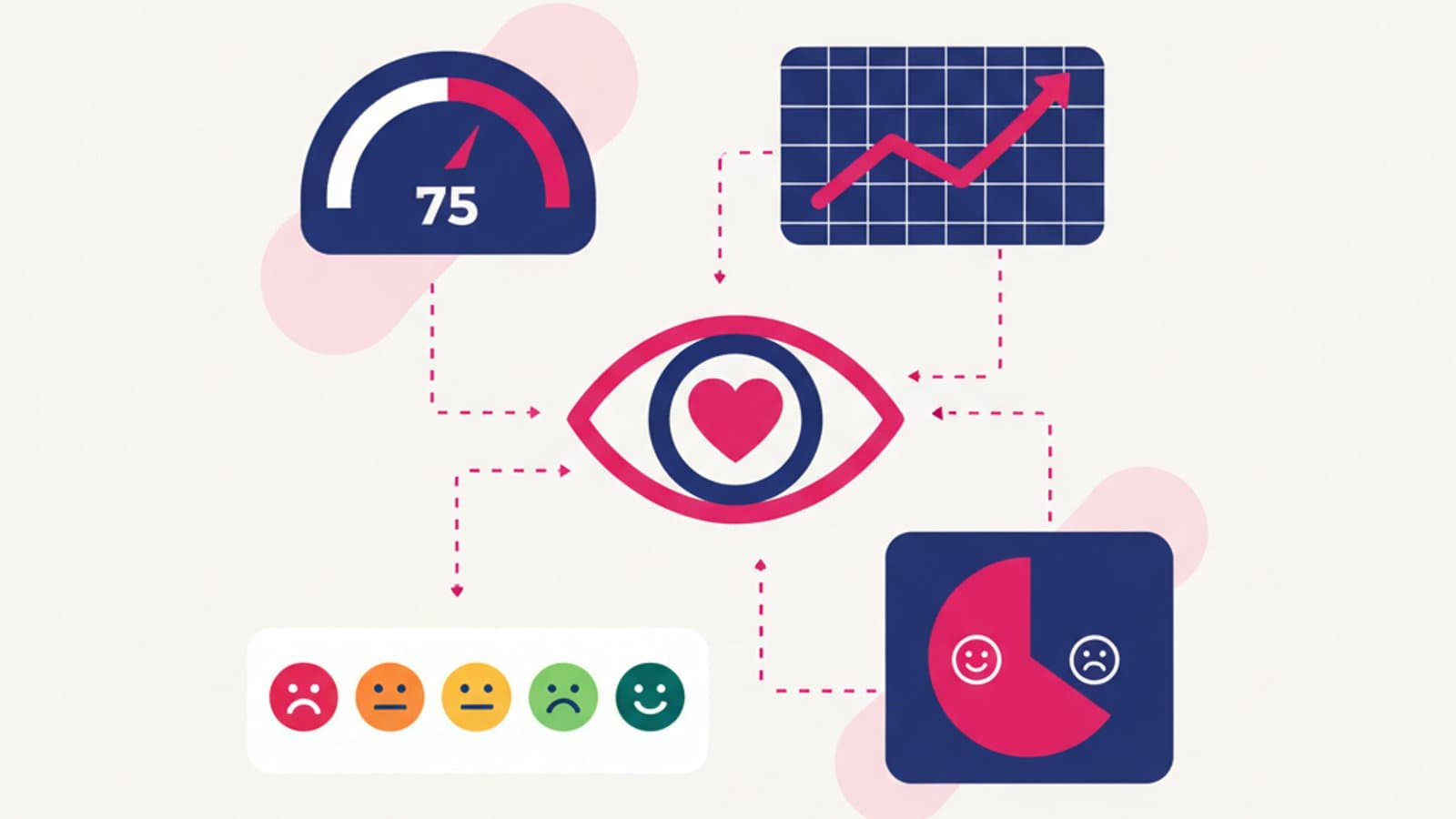
- To measure attitudinal metrics (NPS, CSAT, SUS) in a repeatable way over time.
- To segment users into behavioral clusters.
When NOT to use surveys
- At the start of a new project, when you don't yet know what the right questions are.
- To understand why — surveys measure what, they don't explain.
- When your target isn't used to responding (seniors, non-technical audiences).
Rules for surveys that work
- Max 10-15 questions. Past this threshold, drop-off rates crash.
- Consistent scales. If you use 1-5, always use 1-5; don't mix 1-5 with 1-7 and 1-10.
- Closed questions with targeted open-ended ones. Every 3-4 closed questions, one open.
- Pilot testing. Have 3-5 target users fill out the survey before launching — you'll catch ambiguity issues you missed.
Empathy maps
An empathy map is a synthesis tool: after interviewing N users, you summarize what you've learned in a visual representation of how your typical user thinks, feels, sees, and hears.
A classic empathy map has four quadrants: what they think and feel, what they see, what they say and do, what they hear (from the outside world), plus two sections for pains and gains.
It's not a research tool — it's a tool for synthesizing and communicating research. Its value is that it forces the team to see users as whole people, not as a set of functional requirements.
Common mistake: creating empathy maps based on team assumptions rather than real data from interviews. It becomes an exercise in projection, not synthesis.
Personas
Personas are archetypes of your target users, based on real research data. A well-built persona includes:
- A name, a photo, a quick bio
- The relevant life and work context
- Goals (what they want to achieve)
- Frustrations (what's blocking them today)
- Digital behaviors (what they use, how)
- Real quotes pulled from the interviews
Proto-persona vs real persona Proto-personas are written before doing research, based on team intuition. They're useful for aligning the hypotheses to validate, but they're not a decision-making tool. Real personas emerge after a minimum of 5-10 interviews with users from the segment they represent.
When personas work
When the team has multiple stakeholders (product, marketing, engineering, sales) who tend to imagine different users. A shared persona is a common anchor.
When personas fail
- When they're invented without real research (so-called "marketing personas")
- When the team creates them and then never uses them in decisions
- When there are too many (5+ personas at once = none are remembered)
Rule of thumb: 2-3 personas maximum, deeply rooted in research.
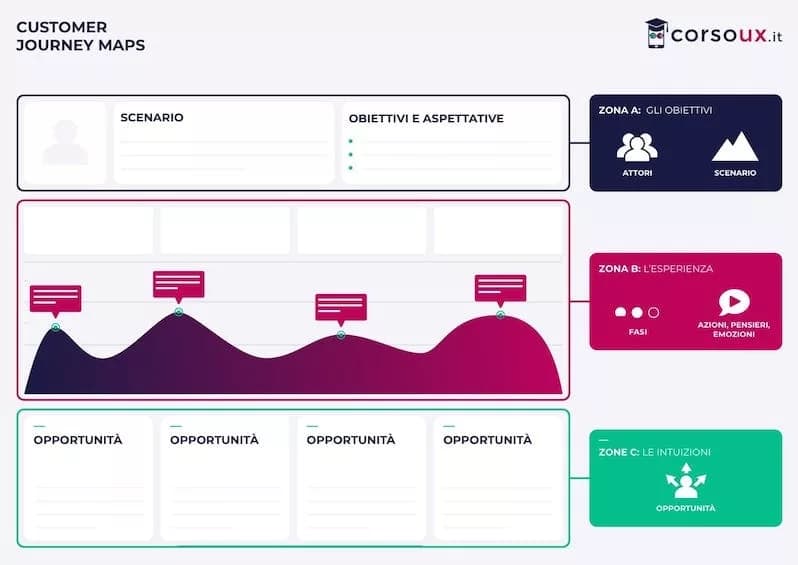
Customer journey map
A customer journey map is a visual representation of the path a user takes to reach a goal with your product or service. It shows stages, actions, thoughts, emotions, touchpoints, and opportunities.
A well-made journey map reveals critical moments that a feature-by-feature analysis doesn't surface:
- The point where the user shifts from curiosity to decision
- Cross-touchpoint frustration moments (e.g., app + customer service + email)
- The improvement opportunities that only emerge when you look at the whole flow
Common mistake: building journeys that are too generic ("discovery → evaluation → purchase → use → support"). A useful journey is specific: "a freelancer's first visit to a site, looking for an alternative to their current CRM after a tough week".
User stories and MVP
User stories are an extension of personas into the product backlog's language. The classic formula:
"As a [type of user], I want to [action] so that [benefit]."
Example: "As a freelancer with 3 recurring clients, I want to send all the month's invoices in one batch, so that I don't have to repeat the same process each time."
User stories translate research into concrete product requirements. In agile teams they're the base on which backlog features are written.
The MVP (Minimum Viable Product) is the product with the smallest set of features sufficient to validate the central product hypothesis. Research guides the MVP by answering: "What's the minimum thing we have to build to learn whether we're solving a real problem?"
Testing techniques
The last big family of methods is testing. It splits into:
- Moderated usability testing: the researcher watches a user perform tasks in real time (5-8 people).
- Unmoderated usability testing: the user performs tasks alone and the tool records (30-100 people). Read the tools guide.
- A/B testing: behavioral comparison on real traffic (thousands of users). A/B testing guide.
- Preference testing: stated opinion on variants. Preference testing guide.
- Eye tracking: measurement of visual attention. Eye tracking guide.
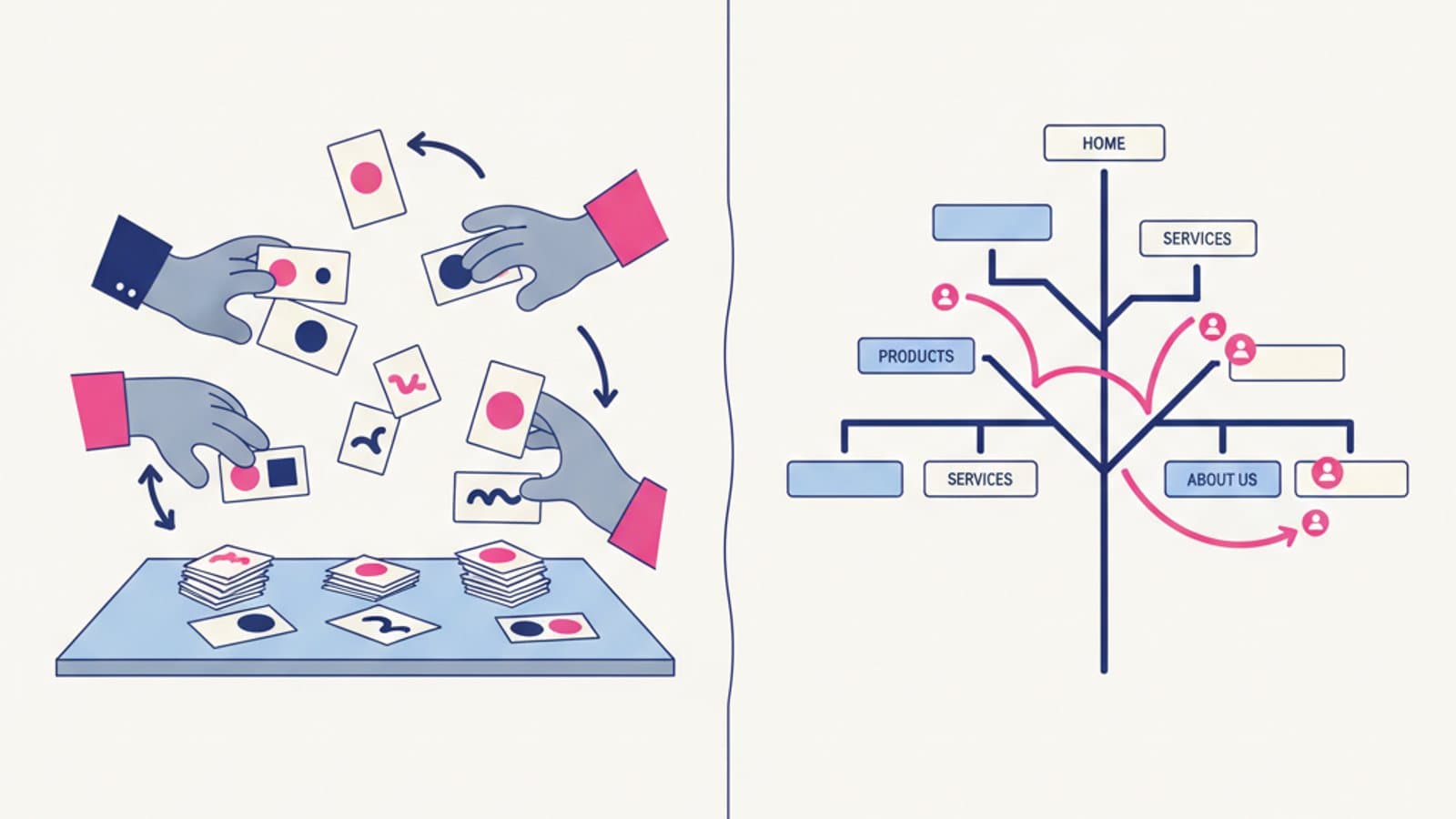
- Card sorting and tree testing: information architecture validation.
The choice depends on the project phase: exploratory (moderated), quantitative validation (unmoderated + A/B), micro-optimization (preference testing + eye tracking).
The user research job market in 2026
The pure User Researcher role has matured significantly in the US and UK over the last 3-4 years but still remains a specialty compared to the generalist UX Designer. Companies that hire dedicated researchers are primarily:
- Fintech and SaaS scale-ups with complex products
- Big tech (Google, Meta, Apple, Amazon, Microsoft all have extensive research orgs)
- Enterprise B2B companies (Salesforce, Workday, ServiceNow)
- Strategic design consultancies (IDEO, frog, Accenture Song)
US User Researcher salaries 2026 (Levels.fyi, Glassdoor):
- Junior: $95-120k base
- Mid: $130-170k base
- Senior: $170-220k base, $250-340k total comp at big tech
- Principal/Staff: $220-300k base, $380-500k+ total comp
UK User Researcher salaries 2026 (Glassdoor UK, LinkedIn Jobs on the Rise):
- Junior: £40-55k
- Mid: £60-80k
- Senior: £85-115k
- Principal: £115-150k+ at London tech companies
Senior researchers with 5+ years of experience are in high demand and negotiate from a position of strength. For the full UX salary picture read the 2026 guide.
How to become a User Researcher
Three typical paths:
From generalist UX Designer to Research specialist: after 2-3 years as a UX generalist, you specialize in research by choosing projects where research is the focus. It's the most common path in the US and UK.
From social sciences/psychology/anthropology: if you have a humanities degree with strong qualitative research methods, you have a massive head start on the core skills. What you need to add is UX vocabulary, basic Figma, and product context.
From Data Science/HCI: if you have a technical-analytical background, the quantitative side is already yours. What you need to add is qualitative sensitivity and the ability to synthesize data into insights.
For the general path read how to become a UX Designer by background.
Frequently asked questions
What's the difference between UX research and market research?
Market research measures the market: how many potential customers, how much they spend, what they think of the brand. UX research measures interaction: how people use a product, where they get stuck, what they say at the moment of use. The two overlap but have different questions, methods, and outputs.
How many users do you need for qualitative research?
For exploratory interviews on a new problem: 5-8 per segment. Past that threshold new information drops off rapidly (saturation). For moderated usability tests: 5 users reveal ~85% of major issues according to Jakob Nielsen's classic research.
Is user research always necessary?
No. For small updates, bug fixes, or features clearly requested by existing data, you don't need formal research. Research is needed when you're making important, irreversible decisions, or when current evidence is contradictory.
How much does user research cost?
Highly variable. An internal qualitative test with 5 self-recruited participants: $300-700 (incentives). A test with an external panel and 50 unmoderated participants: $1,500-3,500. A multi-year study with interviews + surveys + analytics + usability tests: $20,000-60,000.
Does a UX Designer need to know how to do research?
Yes, at least at an operational level. A designer who can't run an interview or analyze test data depends on a researcher for every decision, which slows the team down. Senior dedicated research roles are for strategic studies, but everyday research is part of every designer's craft.
Qualitative or quantitative research — which is better?
The question is wrong: they're complementary. Qualitative to understand why, quantitative to measure how much. Good teams use both in sequence — typically exploratory qualitative, then validating quantitative.
Next steps
If you want to get good at user research, the path is practical, not theoretical:
- Run 5 interviews this week with 5 random people about something that matters to them — no project required, just practice
- Read the preference testing guide and the A/B testing guide to broaden your toolkit
- Study the unmoderated testing tools you'll be using every week
CorsoUX's User Research module takes you from formulating research questions to analyzing data, with exercises on real projects supervised by senior mentors who do research every day.